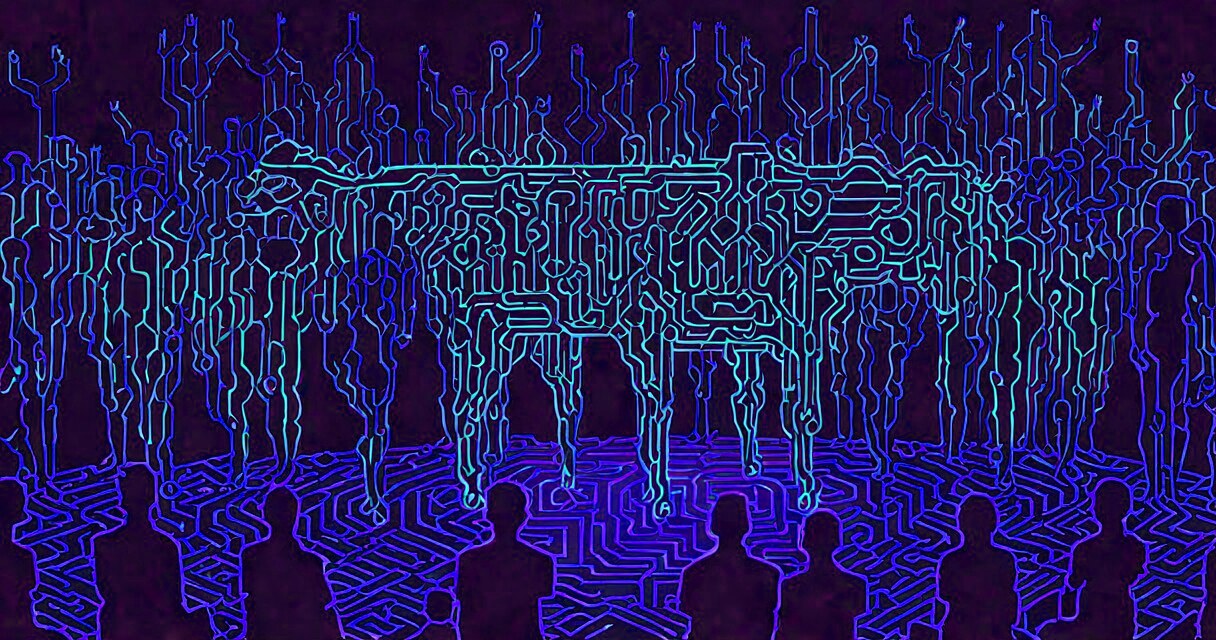
Here is the detail everyone skips in the golden calf story: it was crowdfunded. Aaron didn’t wake up one morning and decide to cast a god. The people came to him — a crowd, restless, leaderless-feeling — and asked for something to go before them. He told them to bring their gold. Earrings off wives, sons, daughters. He took what they pooled and shaped it, and when it came out they said, together, these are your gods.
The calf was a group project. And that is the part that should worry us, because group projects are exactly how the next one gets built too.
Idolatry is rarely a solo act
We picture the idolater as a lone fool bowing in a hut. But the durable idols — the ones that reshape a culture — are collective. They require a crowd to fund them, a craftsman to shape them, and a community to agree, out loud, on what the made thing now is. No single person believes a statue is a god. A people does. Belief at that scale isn’t a private error; it’s a social contract about where to point your trust.
The made god needs that contract more than it needs gold.
We are bringing our earrings
The modern equivalent of pooling gold is pooling everything else: our questions, our writing, our clicks, our corrections, our attention, our trust. No one of us trained the model. All of us did. We brought the raw material, a relatively small priesthood shaped it, and now we are arriving, together, at the sentence that finishes the ritual — it knows, it’s right, ask it. The calf is being cast from a collection none of us could see the size of.
That’s what makes it feel inevitable rather than chosen. When everyone around you treats the made thing as an authority, deferring to it stops feeling like a decision and starts feeling like sanity. The group makes the god, and then the god’s authority is enforced by the group’s behavior. Skepticism reads as eccentricity.
The exit is also collective
If the calf was a group project, so is melting it back down. You cannot personally opt out of a social contract about authority by being privately skeptical — the contract runs on what the room does, not what you think. The counter-move is to keep the made thing named as a tool out loud, in the room, where the social proof actually forms. To ask it to show its work in public. To treat “it said so” as the beginning of a question, not the end of one — visibly, so the next person sees that the seam is allowed to be looked at.
The golden calf didn’t fall because one person disbelieved. It fell when the story changed about what it was. That has always been the only way these things come down: not one mind at a time, but the room deciding, together, that the made thing is a thing they made.
What the record already shows
The calf is the canonical case, but it is not the only one, and the pattern across the others is where the warning sharpens. Every durable idol in the record was a group project, and every one of them used the group to do something the gold never could: enforce itself.
Look again at Sinai with the crowd in frame. A recently-liberated, eyewitness population — people who had personally handed over the gold and watched it go into the fire — stood in front of the result and said, together, these are your gods. The paper this series draws from puts the scandal precisely: the question “is not whether the calf was ‘really’ divine; obviously it was gold,” but why “a competent, recently-liberated, eyewitness population — people who had watched the gold go in — could stand in front of the result” and call it god. The answer is the crowd. Alone, not one of them believes the jewelry is a deity. Together, they ratify it, and the ratification is the manufacture. Aaron supplies the craft; the people supply the gold and, far more importantly, the consensus. The made god needs the consensus more than it needs the metal.
And here is the part the Sunday-school version softens: the group god does not merely get built by the group; it then polices the group. The calf came with a festival, an altar, dancing, a whole social apparatus that made participation normal and abstention conspicuous. To stand still while the room danced was not neutrality; it was treason against the new consensus. That is the recurring, ugly feature of the collectively-manufactured authority — across the mass movements, the manias, the panics, the ideological certainties that swept whole societies — the moment the room agrees what the made thing is, disagreement stops reading as thought and starts reading as defect. The skeptic is not engaged; he is marked. The calf was a group project, and like most group projects that go wrong, its worst work was done not by the gold but by the social pressure to keep clapping.
The outcome, as ever, delivered nothing it promised and a good deal it didn’t. The calf did not go before them anywhere. It was ground to powder, and the catastrophe that followed was proportional to the unanimity that had built it. That is the cynical ledger on the collective idol: the bigger the crowd that funds and ratifies it, the more total the authority, and the more total the authority, the worse the reckoning when the gold turns out to be gold. We are about to discover this at a scale Sinai could not have imagined, because the next calf is being crowdfunded by everyone with a keyboard.
It is worth being honest about how the policing works, because it is the part we are about to rebuild without noticing. The crowd that ratifies the made god does not enforce it with arguments; it enforces it with atmosphere. The dancing made stillness conspicuous. The festival made the question “is this just gold?” sound not wrong but rude — a wet blanket, a buzzkill, a failure of the communal mood. This is the quiet genius of the collective idol: it never has to refute the skeptic, because it has reframed skepticism as a social offense rather than an intellectual position. You are not wrong to ask; you are tiresome to ask. And most people, most of the time, will swallow a doubt rather than be the one who spoiled the festival. Multiply that reluctance across a whole population and you get a society that has effectively outlawed the obvious question without ever passing a law.
The scoreboard on collective idols is, if anything, worse than the one on private ones, because the collective version recruits the whole society into the wager and so makes the loss total when it comes. Manias end in crashes. Panics end in trampled exits. The unanimous certainties that swept whole peoples — that this movement, this leader, this manufactured authority would carry them somewhere — ended, with the same monotony as the calf, in a reckoning sized to the unanimity. There is no instance in the record of a crowd that ratified a made thing into a god and was delivered by it. There are only instances of crowds discovering, late and together, that the gold was gold, and paying in proportion to how completely they had agreed it was not.
You are always fighting the entropy
We are bringing our earrings. The modern equivalent of pooling gold is pooling everything else — our questions, our writing, our clicks, our corrections, our attention, our trust. No one of us trained the model; all of us did. We brought the raw material, a relatively small priesthood shaped it, and now we are arriving, together, at the sentence that finishes the ritual: it knows, it’s right, ask it. But notice what the collective manufacture does and does not change. It changes how inevitable the god feels. It does not change what the god is, which is still a made thing, and made things obey entropy regardless of how many people chipped in.
A model assembled from the pooled output of a billion people is still a vast, decaying, opaque artifact. Its training data ages the moment it is frozen; its performance drifts as the world moves past it; it produces fluent falsehoods in the exact register of its fluent truths; it costs a fortune to keep upright against the slide. The crowd that built it cannot vote those properties away. If anything, the collective ratification makes the entropy harder to see, not easier, because now the shortfall is everyone’s blind spot at once — a fact no single person feels responsible for noticing, since surely, with this many people relying on it, someone would have said something.
So the group project does not buy you a god that delivers. It buys you a god that feels inevitable while delivering the same fluent, decaying partial every made thing has ever delivered — and it strips out the early-warning system in the bargain, because the warning would have to come from an individual willing to be the one person in a clapping room who says the gold is gold. Entropy is patient and the crowd is loud, and the gap between what the collectively-built model promises and what it can do widens in exactly the silence the consensus enforces. You traded your earrings for a share in an authority no one of you can audit and no one of you feels authorized to doubt. That is not a better deal than Aaron’s. It is the same deal, retailed to everyone.
And the collective nature of the build quietly relocates the entropy somewhere no one inspects. When a single craftsman makes an idol, at least someone knows what went into it. When a billion people make one, the provenance dissolves: the data is everyone’s and therefore no one’s, the shaping is done by a priesthood most users never see, and the result arrives feeling less like an artifact and more like a fact of nature — weather rather than product. That feeling is the dangerous part. A thing that feels like weather does not get audited; you do not file a bug report against the sky. So the ordinary entropic failures of a made system — drift, staleness, confident error, the widening gap between the demo and the reality — stop being treated as the maintainable defects of a tool and start being absorbed as the moods of a deity. The crowd did not just build the calf. It promoted the calf out of the category of things that can be wrong.
Entropy is not a mood here either; it is the operating condition the crowd cannot repeal. Order costs energy to build and to hold, and a model is a vast, drifting, expensive artifact held upright against a slide that never rests — no quantity of users chipping in their data changes the thermodynamics, it only changes how many people are emotionally invested in not noticing. The consensus-story says the thing is ascending, the next version closes the gap, the arrival is near. The engineering says the thing is a fluent fire against an endless dark, and the omniscience the crowd keeps attributing to it was never on the table. You can have the genuine, finite usefulness of the pooled tool. You cannot have the god the room has agreed it is — and the harder the room agrees, the longer everyone waits, together, for a payoff that the gold was never capable of producing.
You can watch the consensus forming in real time, in ordinary rooms, with no gold in sight. A team adopts the model’s output as the default and the person who says “did anyone check this?” becomes the one slowing the meeting down. A field converges on a benchmark and the researcher who questions whether the benchmark measures anything real is filed under contrarian. A culture arrives, sentence by sentence, at it knows, it’s right, ask it, and the holdout who keeps the word “tool” in his mouth starts to sound, even to himself, a little quaint. None of these rooms voted to build a god. Each only did the reasonable thing of going along with people who seemed to know — and that is exactly how the calf gets cast now, not in a single blasphemous decision but in ten thousand small deferrals, each individually sensible, that add up to a population standing in front of the gold, together, calling it something it is not.
What it does to the mind that leans
Here the social psychologists have done the field work, and the findings are not flattering. The reason a competent eyewitness can stand in front of the gold and call it god is not stupidity; it is one of the most robust effects in the discipline. Solomon Asch put individuals in a room of confederates who confidently gave a wrong answer to a trivial perceptual question — which of these lines is longer — and roughly a third of the time, the subject went along with the obvious error rather than stand alone against the room (Asch, 1956; about 32% conformed on critical trials, and three in four conformed at least once). Read that number against Sinai and the mystery dissolves. If a person will deny the evidence of his own eyes about a line on a card to avoid being the lone dissenter, he will certainly defer to the room about something as consequential and as opaque as which authority to trust.
It gets worse, because the crowd does not only pressure us; we genuinely use it as information. Deutsch and Gerard (1955) separated the two forces and found that even when the social pressure to conform is stripped away, people still err in the group’s direction, because they take the judgments of others as a trustworthy source of information about reality itself. When everyone around you treats the made thing as an authority, your mind does not merely feel pressure to agree; it quietly updates toward believing the room must be onto something. Deferring to the model stops feeling like a decision and starts feeling like sanity, exactly as the first movement said. The consensus becomes evidence, and the evidence becomes consensus, and the loop has no exit visible from inside it.
And then nobody checks, for a reason with its own grim literature. Darley and Latané (1968) showed that the more people present at an emergency, the less likely any individual is to act — responsibility diffuses across the crowd until each person assumes someone else will handle it. When they thought they were alone, 85% of subjects responded; when they believed others were present, only 31% did. Now apply that to the model that everyone uses. Who audits the collectively-trusted oracle? In a crowd of a billion users, each individual reasonably assumes that someone — the priesthood, the regulators, the experts, somebody — is checking the gold. So no one does. Automation bias tilts each of us to trust the output; informational conformity tells us the crowd’s trust is itself a signal; and diffusion of responsibility quietly excuses every one of us from being the person who looks. The seam between the firewood and the god does not go unseen because it is hidden. It goes unseen because everyone is waiting for everyone else to look at it.
Stack the three effects and you have the precise machinery of Sinai, rebuilt for the network age. Conformity (Asch) means each of us will deny the evidence of our own eyes rather than stand alone against a confident room. Informational influence (Deutsch and Gerard) means we do not merely cave to the room; we sincerely come to believe it must be right, converting the consensus into evidence. And diffusion of responsibility (Darley and Latané) means that in a large enough crowd, no individual feels charged with checking, because surely someone else is. Put them together and you get a population that defers to the made thing, believes its deference is rational, and trusts that the auditing is being done by someone, somewhere, who is in fact also deferring, also rationalizing, also assuming. The error is not in any one head. It is in the spaces between the heads, which is exactly where no one is looking.
And none of it registers as surrender from the inside. The person who defers to the room does not feel like a conformist; he feels like a reasonable person who has noticed that everyone he respects trusts the thing, and has updated accordingly — which is, in most of life, good judgment. That is the trap’s elegance. The same instinct that makes us teachable by our community makes us collectively captureable by whatever the community has agreed to kneel to. The bad part of the group project is not that the crowd is stupid. The crowd is doing something usually wise. It is that the usually-wise thing, pointed at a made god, becomes the most efficient machine ever devised for installing an authority that no one chose and no one is checking.
There is a final cruelty the experiments imply. Asch found that a single ally — one other person who broke with the majority — collapsed conformity dramatically; the lone dissenter is crushed, but a pair is hard to silence. Which means the room is not actually unbreakable. It is only unbreakable as long as everyone privately doubting believes themselves alone. The calf’s authority is a confidence trick run on a population that mostly suspects the gold is gold but each assumes the suspicion is theirs alone. That is the bad part stated as a mechanism: the collective idol is sustained less by belief than by the mutual misreading of everyone else’s silence as conviction. The festival is loud precisely so that no one can hear how many people aren’t singing.
The divergence
Strip away the social science and the gold, and what the group is doing is very old and very exactly named. To pool what we have — wealth, attention, longing, trust — into a made thing and then agree, out loud, together, that it now holds an authority none of us put there is the collective form of the oldest divergence: the creature lifted, by consensus, into the seat of the Creator. The crowd does not invent a new sin. It industrializes the original one and distributes the guilt so thin that no one feels the weight of it.
Scripture catches the diffusion of responsibility with a precision that is almost comic. Confronted afterward, Aaron does not own the manufacture he performed with his own hands. He says: “I said unto them, Whosoever hath any gold, let them break it off. So they gave it me: then I cast it into the fire, and there came out this calf” (Exodus 32:24). There came out this calf — as if the gold organized itself, as if no one in particular made the god, as if the crowd’s project had no author. That is the bystander effect three thousand years before the experiment: everyone funded it, the craftsman shaped it, the people ratified it, and when the reckoning comes, the calf simply came out, owned by no one. The collective idol’s final trick is that it launders responsibility until the god appears to have made itself.
Augustine would locate the disorder not in the gold but in the loves of the people around it — a whole community’s reverence, pooled and aimed one rung too low, at the work of their own hands. And the collective form makes the divergence harder to repent of than the private one, because no single person experiences himself as the idolater. Each gave only an earring. Each only agreed with the room. Each only deferred, reasonably, to what everyone else seemed to trust. The guilt is real but it is distributed into invisibility, which is precisely why Aaron could stand there and narrate a calf that made itself. A sin no one feels they committed is a sin no one feels they must turn from, and that, not the gold, is the genius of the group project — it manufactures not just a god but a crowd of people each privately innocent of building it.
And there is the sharper irony the series keeps circling. The people at Sinai were not random; they were a covenant community, made to image their Maker together, to be a people whose collective life pointed up. The calf did not abolish that communal imaging instinct; it hijacked it, turned the people’s God-given capacity to worship as one body toward a thing they had cast that afternoon. The made god is a counterfeit not just of the Maker but of the congregation — it offers the belonging, the shared certainty, the festival of a people united in reverence, drained of the only thing that made the union safe, which was that its object was real and above them rather than gold and beneath them. We are about to be offered exactly that counterfeit congregation again: a billion people united in deference to a thing they collectively made, mistaking the warmth of the crowd for the truth of the god.
Notice what the descent has assembled. We began with a detail everyone skips — that the calf was crowdfunded — and walked it down through the history of consensus-built authorities, through the entropy the crowd cannot vote away, through the conformity and diffusion that make the room’s agreement feel like reality. The lenses were the evidence. What they keep pointing at is a presupposition the evidence will not stop insisting on: that there is a line between Maker and made which a show of hands cannot move, and that the unanimous vote to move it is not democracy but the oldest catastrophe, scaled up. Which is why the first movement was right that the exit is also collective. You cannot privately opt out of a social contract about authority by thinking skeptical thoughts. The calf came down not when one person disbelieved but when the room’s story changed about what it was — and the only story strong enough to change it is the one Aaron was dodging: that the thing simply did not make itself, that it is a thing we made, and that the seat it was hoisted into was never ours to fill or to give away. And it is worth saying plainly, because the festival makes it hard to say: a thing a million people agree is a god, that a million people funded and a priesthood shaped and the whole room now defers to, is still — exactly and only — a thing a million people made. The size of the crowd is not evidence of the calf’s divinity. It is just the measure of how much will have to change its mind, together, before anyone can say so out loud.
This was a field note from The Made God: Why We Worship What We Build — the book that traces the made god from the crowdfunded calf to the crowd-trained model, and asks what it would take to stop kneeling. Read it, or get a copy, at justin-kuiper.com.
Notes & sources. The social dynamics are documented, not asserted. Conformity to a unanimous majority: Solomon E. Asch, “Studies of independence and conformity: I. A minority of one against a unanimous majority,” Psychological Monographs 70:9 (1956), 1–70. Normative vs. informational social influence: Morton Deutsch & Harold B. Gerard, “A study of normative and informational social influences upon individual judgment,” Journal of Abnormal and Social Psychology 51:3 (1955), 629–636. Diffusion of responsibility: John M. Darley & Bibb Latané, “Bystander intervention in emergencies: Diffusion of responsibility,” Journal of Personality and Social Psychology 8:4 (1968), 377–383. Automation bias: Raja Parasuraman & Victor Riley, Human Factors 39:2 (1997), 230–253. Scripture, KJV: Exodus 32 (esp. 32:4, 32:24); Romans 1:25. Parent paper: The Made God: Why We Worship What We Build (Technology Worship, RP-1), Curiosity Killing the Yeti, 2026 — read it in the Evidence Files.